





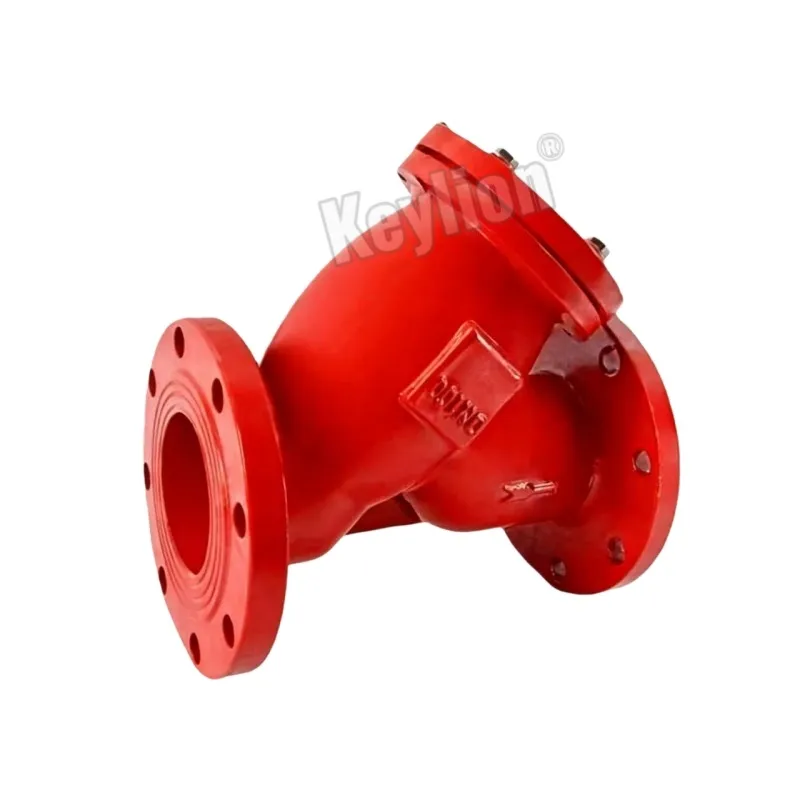
Y Type Filter Strainer
Product Overview
Y Type Filter Strainer is a pipeline filtration device designed to remove suspended particles and debris from water and sewage systems. It protects downstream equipment from clogging and wear, improves system reliability, and reduces maintenance frequency.

Key Features
Stainless steel strainer basket effectively captures solid particles and reduces downstream equipment contamination.
Ductile iron body construction provides high mechanical strength and stable performance under pressure conditions.
Flanged connection design supports standardized installation and replacement in pipeline systems.
Removable bonnet structure simplifies strainer cleaning and routine maintenance operations.
Technical Specifications
| Item | Specification |
| Product Name | Y Type Filter Strainer |
| Body Type | Flanged |
| Size Range | DN50–DN300 (2"–12") |
| Pressure Rating | PN10 / PN16 / PN25 |
| Working Medium | Water / Sewage |
| Temperature Range | 0°C–80°C |
| Flange Standard | ANSI / GB / BS |
| Color | Blue / Red |
Material Details
| Part | Material |
| Body | Ductile Iron QT450-10 |
| Bonnet | Ductile Iron QT450-10 |
| Seal | NBR |
| Strainer Basket | Stainless Steel 304 |
| Bolt | Stainless Steel 304 |
| Nut | Stainless Steel 304 |
Application Scenarios
Water Treatment
Raw water inlet pipelines
Filtration station pipelines
Pump protection systems
Water distribution pipelines
Wastewater Systems
Sewage transfer pipelines
Pump stations
Treatment process lines
Sludge handling systems
General Pipeline
Valve protection systems
Flow meter protection systems
Heat exchange equipment inlet lines
Mechanical equipment upstream filtration points
Quality Assurance
Raw Material Inspection: Chemical composition and mechanical property verification for ductile iron and stainless steel materials.
Dimensional Inspection: Critical dimensions checked according to approved production drawings.
Pressure Testing: Hydrostatic pressure test performed on valve body and assembly.
Surface Inspection: Coating thickness and appearance inspection after painting process.
Seal Performance Test: Leakage testing under specified pressure conditions.
Assembly Inspection: Fastener torque and component installation verification.
Traceability Control: Production batch identification and inspection record management.
Certifications Available: ISO 9001, Material Test Report (MTR), Pressure Test Report, Certificate of Conformity (COC).
Customization Options
| Item | Available Options |
| Logo Marking | Laser marking / Casting logo / Nameplate |
| Packaging | Carton / Plywood case / Export pallet |
| Flange Standard | ANSI / DIN / BS / GB / JIS |
| Material Upgrade | SS304 / SS316 strainer / Full stainless steel body |
| Coating | Epoxy coating / Anti-corrosion coating |
| Color | Blue / Red / Custom RAL color |
| Pressure Class | PN10 / PN16 / PN25 / Customized |
| Seal Material | NBR / EPDM / Viton |
| Mesh Size | Customized mesh opening |
| Connection Type | Flanged customization |
FAQ
Hot Tags: y type filter strainer, China y type filter strainer manufacturers, suppliers, factory, 3 Inch Y Strainer, Ductile Iron Y Strainer, Y Strainer Cast Iron, Y Strainer Pn16, Y Type Filter Strainer, Y Type Strainer Valve
Previous
No InformationYou Might Also Like


Send Inquiry