





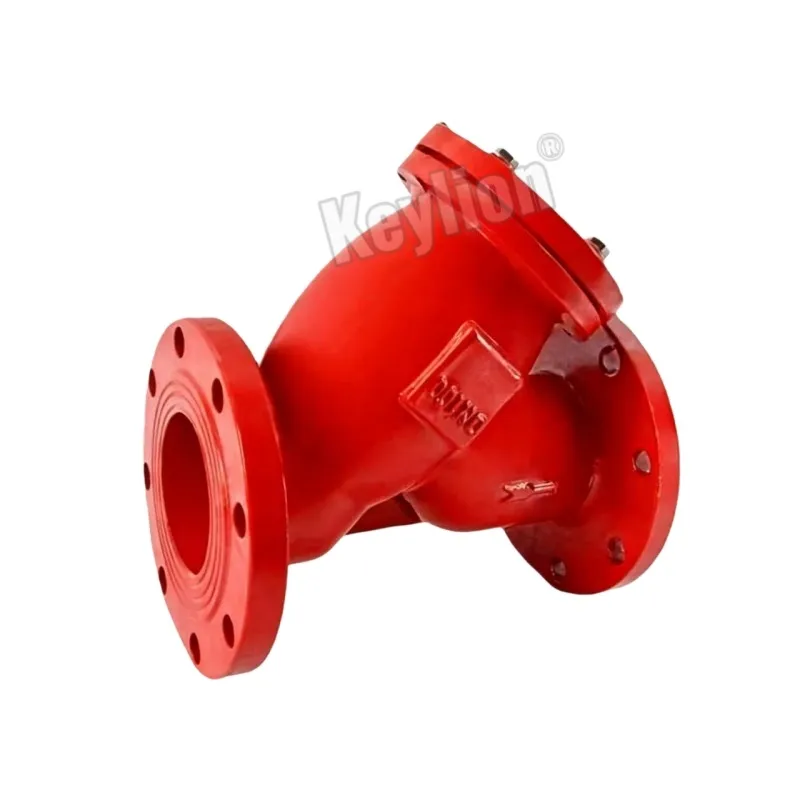
Y Strainer Cast Iron
Y Strainer Cast Iron is a pipeline filtration component designed to remove suspended particles and debris from water and sewage systems.
Send Inquiry
Product Introduction
Product Overview
Y Strainer Cast Iron is a pipeline filtration component designed to remove suspended particles and debris from water and sewage systems. It protects downstream equipment such as pumps, valves, and meters from blockage and wear.

Technical Specifications
| Item | Specification |
| Product Name | Y Strainer Cast Iron |
| Body Type | Flanged |
| Available Sizes | DN50, DN65, DN80, DN100, DN125, DN150, DN200, DN250, DN300 |
| Pressure Rating | Class 150lb |
| Working Medium | Water, Sewage |
| Temperature Range | 0°C–80°C |
| Flange Standard | ANSI / GB / BS |
| Available Colors | Blue / Red |
Material Details
| Part | Material |
| Body | Ductile Iron QT450-10 |
| Bonnet | Ductile Iron QT450-10 |
| Seal | NBR |
| Strainer Basket | Stainless Steel 304 |
| Bolt | Stainless Steel 304 |
| Nut | Stainless Steel 304 |
Application Scenarios
Water transmission pipelines
Sewage transfer systems
Pump inlet protection systems
Water meter protection systems
Valve protection assemblies
HVAC circulation pipelines
Municipal water distribution systems
Industrial cooling water systems
Fire protection water pipelines
Irrigation and drainage systems
Quality Assurance
Raw material inspection for chemical composition and mechanical properties
Dimensional inspection according to flange and casting tolerances
Pressure testing for body strength and sealing integrity
Hydrostatic leakage test before shipment
Surface coating inspection for coating thickness and adhesion
Mesh inspection for strainer accuracy and structural consistency
Assembly verification for fastening torque and component fitment
ISO 9001 quality management system
CE certification available upon request
Material Test Report (MTR) available for designated projects
Customization Options
| Item | Available Options |
| Logo Marking | Cast logo, laser marking, nameplate |
| Packaging | Carton box, plywood case, pallet packaging |
| Flange Standard | ANSI, DIN, JIS, BS, GB |
| Material Upgrade | SS316 strainer, EPDM seal, full stainless steel body |
| Surface Coating | Epoxy coating, anti-corrosion coating |
| Color | Blue, Red, Black, customized color |
| Pressure Class | Class 125, Class 150, PN10, PN16 |
| Mesh Size | Customized filtration mesh size |
| Connection Type | Flanged, threaded |
| OEM/ODM | Supported |
FAQ
Hot Tags: y strainer cast iron, China y strainer cast iron manufacturers, suppliers, factory, Ductile Iron Y Strainer, Wye Type Strainer, Y Shaped Strainer, Y Strainer Pn16, y type strainer, Y Type Strainer Valve
Previous
Y Strainer Pn16You Might Also Like


Send Inquiry