Introduction
Industrial piping systems rely on precise and reliable flow control to ensure safety, efficiency, and operational stability. Across industries such as oil and gas, water treatment, power generation, and chemical processing, fluids must be transported, isolated, and managed under a wide range of pressures and temperatures. At the center of this infrastructure are valves-mechanical devices designed to regulate or stop fluid flow within pipelines.
Among the many types of valves used in industrial systems, the Gate Valve is one of the most widely recognized and commonly applied for isolation purposes. Unlike throttling valves that regulate flow, gate valves are primarily designed for full open or full close operation, offering minimal resistance when fully opened and tight shutoff when closed.
A particularly important variation of this design is the Rising Stem Gate Valve, which provides a clear visual indication of valve position through the upward or downward movement of its stem. This feature makes it highly valuable in industrial environments where quick and accurate status identification is essential for operational safety.
The Rising Stem Gate Valve combines mechanical simplicity with robust performance, making it suitable for high-pressure, high-temperature, and demanding industrial applications. Its design has remained largely consistent over decades because of its reliability, durability, and effectiveness in isolating flow.
This article provides a comprehensive exploration of how Rising Stem Gate Valves work in industrial systems. It covers their structure, operating principles, applications, advantages, and limitations, offering a detailed understanding of why this type of Gate Valve continues to play a critical role in modern engineering.
1. Understanding Gate Valves in Industrial Engineering
What Is a Gate Valve?
A Gate Valve is a linear motion valve designed to either fully open or fully close the flow of fluid in a pipeline. It operates by lifting or lowering a gate-like disc perpendicular to the flow direction. When fully open, the gate is completely removed from the flow path, allowing fluid to pass through with minimal resistance. When closed, the gate blocks the flow entirely, providing a tight seal.
Unlike globe valves or ball valves that can regulate flow, gate valves are not designed for throttling. Instead, they are used in applications where flow needs to be either completely allowed or completely stopped.
The primary advantage of a Gate Valve lies in its low pressure drop when fully open. Because the flow path is unobstructed, fluids can pass through the valve with minimal turbulence and energy loss. This makes gate valves ideal for large pipeline systems where efficiency is critical.
Gate valves are widely used in industries such as oil and gas, water distribution, steam systems, and chemical processing. Their simple design and reliable performance make them a foundational component in industrial flow control systems.
Types of Gate Valves
There are several types of gate valves used in industrial applications, each designed for specific operational requirements.
Rising Stem Gate Valves
In this design, the stem moves upward when the valve is opened and downward when it is closed. This movement provides a clear visual indication of valve position, which is highly useful in industrial environments.
Non-Rising Stem Gate Valves
In this type, the stem does not move vertically. Instead, it rotates inside the valve body to raise or lower the gate. These valves are used in applications where vertical space is limited.
Wedge Gate Valves
Wedge gate valves use a wedge-shaped gate to create a tight seal between the seats. This design improves sealing performance under high pressure conditions.
Parallel Gate Valves
Parallel gate valves use a flat gate between two parallel seats. They are often used in low-pressure systems where tight sealing is less critical.
Each type of Gate Valve offers specific advantages depending on system requirements such as pressure, temperature, space constraints, and maintenance needs.
Key Components of a Gate Valve
A Gate Valve consists of several essential components that work together to control fluid flow:
Valve Body and Bonnet
The valve body contains the internal flow path, while the bonnet covers the top opening and supports internal components. These parts are typically made from cast iron, carbon steel, stainless steel, or alloy materials depending on application conditions.
Gate (Disc)
The gate is the main flow-blocking component. It moves up and down to open or close the flow passage.
Stem
The stem connects the gate to the external actuator (usually a handwheel or motor). It converts rotational motion into linear motion.
Seats
Seats provide the sealing surface between the gate and valve body. Proper sealing is essential for preventing leakage.
Actuation Mechanism
Gate valves are typically operated manually using a handwheel, but they can also be automated using electric, pneumatic, or hydraulic actuators.
2. What Is a Rising Stem Gate Valve?
Definition and Operating Concept
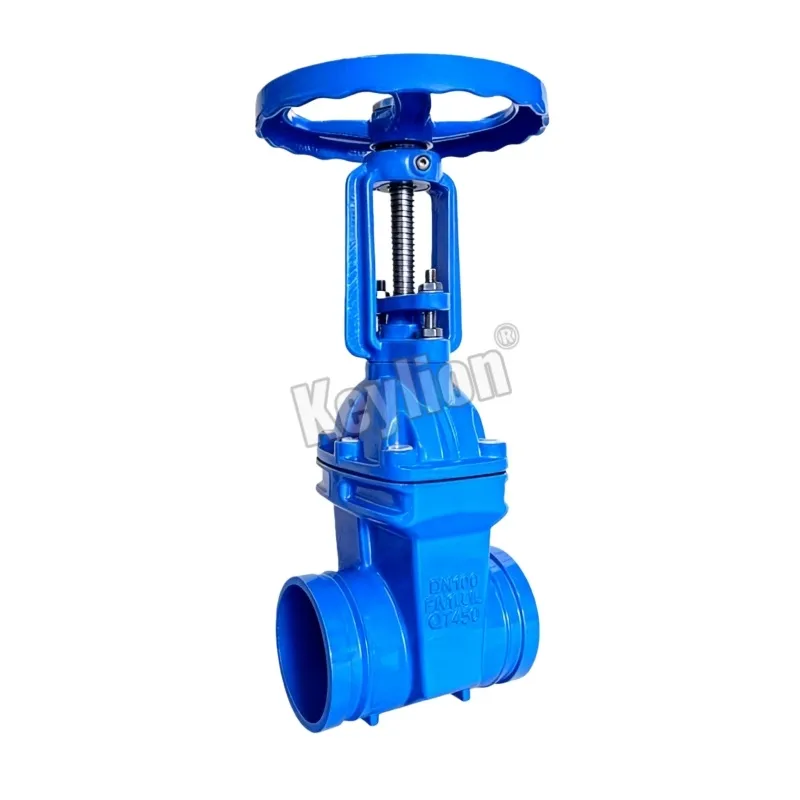
A Rising Stem Gate Valve is a type of Gate Valve in which the stem moves vertically as the valve is operated. When the valve is opened, the stem rises upward; when it is closed, the stem moves downward.
This upward and downward movement is directly connected to the position of the gate inside the valve. As the stem rises, the gate is lifted out of the flow path, allowing fluid to pass through the pipeline. When the stem lowers, the gate returns to its seat, blocking flow completely.
One of the key advantages of this design is that it provides a clear visual indication of whether the valve is open or closed. Operators can immediately determine valve status simply by observing the position of the stem.
Structural Design of Rising Stem Gate Valve
The structural design of a Rising Stem Gate Valve is engineered to allow smooth vertical stem movement while maintaining a sealed and pressure-resistant system.
External Threaded Stem Design
Most rising stem gate valves use an external threaded stem connected to a handwheel. As the handwheel is turned, the stem moves upward or downward depending on rotation direction.
Gate Connection
The stem is connected to the gate inside the valve body. This connection ensures that linear stem movement directly controls gate position.
Bonnet Design
The bonnet houses the stem and provides a sealed passage that allows vertical movement while preventing fluid leakage. It also supports pressure containment within the valve body.
Types of Rising Stem Mechanisms
Outside Screw and Yoke (OS&Y)
The OS&Y design is the most common type of rising stem gate valve. In this configuration, the threaded portion of the stem is located outside the valve body, making it easy to lubricate and inspect.
Internal Lifting Mechanisms
Some designs use internal mechanisms where the stem movement is partially contained within the valve structure, though these are less common in heavy industrial systems.
Manual and Automated Configurations
While manual operation using a handwheel is standard, modern systems often integrate electric or pneumatic actuators for remote or automated control.
3. Working Principle of Rising Stem Gate Valves
Opening Mechanism
The opening process begins when the operator rotates the handwheel. This rotational motion is converted into linear motion through the threaded stem mechanism.
As the stem rotates, it moves upward, pulling the gate away from the flow path. Once fully open, the gate is completely lifted into the bonnet area, allowing fluid to pass through the valve with minimal resistance.
This full-bore design ensures that the pipeline maintains nearly uninterrupted flow, reducing energy loss and pressure drop.
Closing Mechanism
To close the valve, the handwheel is rotated in the opposite direction. The stem moves downward, pushing the gate into contact with the valve seats.
As the gate presses against the seats, it forms a tight seal that blocks fluid flow entirely. This isolation function is essential for maintenance operations and emergency shutdown scenarios.
Flow Characteristics
Gate valves are designed for full open or full close operation, not flow regulation. When fully open, the flow path is straight and unobstructed, resulting in minimal turbulence and pressure loss.
However, using a Gate Valve in a partially open position is not recommended. Partial opening can cause vibration, erosion of the gate and seats, and unstable flow conditions.
Sealing Performance
Sealing performance depends on the design and materials used. Metal-to-metal sealing is common in high-temperature applications, while soft-seat designs are used where tighter shutoff is required.
High-quality sealing is critical in industrial systems to prevent leakage, especially in hazardous or high-pressure environments.
4. Applications of Rising Stem Gate Valves in Industrial Systems
Oil and Gas Pipelines
In oil and gas systems, Rising Stem Gate Valves are used to isolate pipeline sections during maintenance or emergency shutdowns. Their ability to provide tight sealing under high pressure makes them ideal for crude oil, natural gas, and refined product transport.
They are commonly installed in upstream, midstream, and downstream operations, including refineries and distribution networks.
Water Supply and Wastewater Systems
Municipal water systems rely heavily on Gate Valves for controlling distribution networks. Rising stem designs are often used in pump stations, reservoirs, and main pipelines.
They allow operators to quickly identify valve status during maintenance or emergency situations.
Power Plants and Steam Systems
In thermal power plants, Gate Valves are used to control high-temperature steam and boiler feedwater systems. Their ability to handle extreme pressure and temperature conditions makes them essential for safe plant operation.
They are also used in cooling water systems and auxiliary pipelines.
Chemical and Process Industries
Chemical processing plants use Rising Stem Gate Valves to isolate corrosive or hazardous fluids. Depending on the application, valves may be made from stainless steel or specialized alloys to resist chemical attack.
They are commonly used in reactors, storage tanks, and transfer pipelines.
5. Advantages and Limitations of Rising Stem Gate Valves
Advantages
Clear Position Indication
One of the most significant advantages is the visible stem movement, which clearly indicates whether the valve is open or closed.
Low Pressure Drop
When fully open, the valve provides a straight flow path with minimal resistance.
Strong Sealing Capability
Gate valves offer reliable shutoff performance, especially in high-pressure systems.
Durability and Long Service Life
With proper maintenance, Gate Valves can operate reliably for many years in demanding environments.
Limitations
Large Installation Space Requirement
Because the stem rises during operation, vertical space is required above the valve.
Slow Operation Speed
Gate Valves require multiple turns of the handwheel, making them slower to operate compared to quarter-turn valves.
Not Suitable for Throttling
Using the valve for flow regulation can cause damage to internal components.
Maintenance Requirements
Thread lubrication and periodic inspection are necessary to ensure smooth operation.
Conclusion
The Gate Valve, particularly the Rising Stem Gate Valve, remains one of the most reliable and widely used flow isolation devices in industrial systems. Its simple yet effective design allows operators to fully open or close fluid pathways with minimal pressure loss and high sealing reliability.
The rising stem mechanism provides an additional advantage by offering clear visual confirmation of valve status, improving operational safety and reducing the risk of human error.
Across industries such as oil and gas, water treatment, power generation, and chemical processing, Rising Stem Gate Valves continue to play a vital role in ensuring system integrity and operational efficiency.
Despite the emergence of more advanced valve technologies, the Gate Valve remains a foundational component of industrial flow control due to its durability, simplicity, and proven performance in demanding environments.